
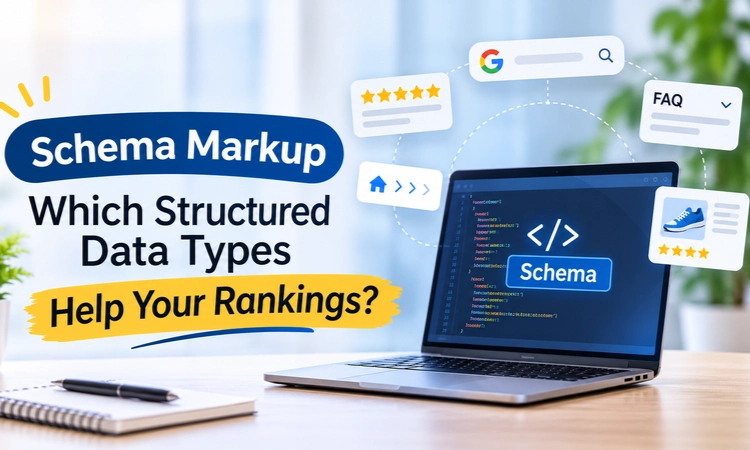
For the evolving landscape of search, getting the content for ranking is no longer about some keywords or backlinks. The AI models and search engines have to understand your content; just read it. That’s where the schema markup that will come into play.
If you need to dominate the search engine pages (SERPs) plus capture those valuable rich snippets, implement structured data for one of the most effective technical SEO tactics available. This type of complete guide will break down exactly what type of schema is, that type actually moves the needle for 2026, and how to implement it without even breaking your site.
If you’re wondering what schema markup is in SEO, then think of that as the translator for the search engines. The schema markup is a general vocabulary of code (basically written under JSON-LD) that you’ve added for your website’s HTML.
While humans can easily look for the webpage and understand the string of numbers for a phone number or the price, the search engine bots require explicit labels. The schema provides these types of labels, actually telling Google, “This is the product” or “This is the event.” By providing clear schema markup examples for the search engines, you actually remove the guesswork plus help them categorize the content accurately.
Does Schema Markup Improve Rankings? (The Honest Answer)
Let’s clear this major myth quickly. The schema markup is not a direct ranking factor. Google has actually stated that adding in structured data will not just push the page from position 10 to position 1.
Although, does schema markup help SEO in an indirect way? Yes, this is what that does:
- Helps Google understand the content and entities: This clarifies the context of your page; that’s the foundational element of modern search algorithms.
- Makes you eligible for rich results: Rich snippets (like the star ratings, product prices, and FAQs boxes) that can significantly increase CTR (Click-Through Rate), and higher CTR that can often lead towards better rankings over time.
- Supports visibility in AI-driven search: As the overviews and conversational search grow, schema markup for AI search becomes important. The structured data will help in machine interpretation, summarizing, and confidently citing the content towards the structured source.
Schema Types That Matter Most
Not all the schema that’s created is equal. Focus on the efforts for those 5 high-impact types:
- Organization / Local Business Schema
What that does: Defines the company’s name, contact info, logo, social profiles, and operating hours.
Who should use it: Each business, specifically those that rely on the schema markup for local business for dominating the local map packs as well as knowledge panels.
- Product & Offer Schema
What That Does: Availability and display price, as well as review ratings directly for the search results.
Who should use it: The SaaS and e-commerce businesses that have tiered pricing.
- Article/BlogPosting Schema
What That Does: Helps Google identify the headline, publish date, and author, as well as the featured image, based on your content.
Who Can Use It: Bloggers, publishers, and other companies that have the active content strategy.
- Breadcrumb Schema
What That Does: Shows the hierarchy path of a certain page (for instance, Home > Services > SEO) for the search results.
Who Should Use It: Websites that have deeper navigation structures, improving both the crawlability and UX.
- Review/AggregateRating Schema
What That Does: Generation of those eye-catching gold stars that’s next to your search listings.
Who Should Use It: E-commerce and local businesses, along with service providers that have genuine customer feedback.

Schema Types That No Longer Work
Google some days ago retired its visually rich results for FAQ as well as HowToSchema, this reserving them generally for the government as well as certain health sites. While you add these aids for machine understanding behind the scenes, do not expect the visual SERP payoffs. Do verify the basic eligibility for the official document of Google.
Which Schema Should You Use? (By Business Type)
Business Types | Recommended Schema Types |
Clinic or local Business | Organization, Local Businesses, Review, Breadcrumb |
Content Site or blogger | Person, Article, Breadcrumb, Organization |
E-commerce Store | Product, Offer, Breadcrumb, Review, Organization |
SaaS Company | SoftwareApplication, Organization, FAQ, Article |
Agency or Consultant | Service, Organization, Person, Review |
How to Add Schema Markup (5 Steps)
- Choose: Match the schema for the page’s primary purpose.
- Generate: Using a highly reliable schema markup generator, as in Google’s Markup Helper.
- Add: Pasting the JSON-LD for the <head> through SEO plugins (Yoast, Rank Math), theme settings, or Google Tag Manager.
- Test: Validating the code through the use of a schema markup testing tool, as in Google’s Search Results.
- Monitor: Checking GSC (Google Search Console) “Enhancement” reports under successful indexing.
Common Mistakes to Avoid
Never make up the invisible content, use any type of fake reviews, omit those required fields, or duplicate that schema through multiple plugins, or you can apply the wrong type (e.g., product schema on the service page)
How to Measure Success
Tracking performance via GSC through the use of CTR for 4 to 6 weeks, before and after implementation. Monitor the enhancements report for errors, but remember the rich results are never guaranteed.
Frequently Asked Questions
Is schema markup necessary for SEO?
This is highly recommended for SEO towards standing out, plus feeding the AI models, though this is not a direct ranking factor.
What is the best schema format, JSON-LD or Microdata?
JSON-LD is the preferred and easiest-to-implement format.
Does schema help with AI search and ChatGPT visibility?
Yes, the schema markup for AI search can provide clear, plus machine-readable entity relationships for the LLMs to cite that accurately.
Conclusion
Mastering the schema markup is an important requirement for those modern digital marketing strategies. This can amplify the CTR, clarify the content for AI, and build tropical authority. For the flawless integration aligned with top SEO strategies, partner with a highly reliable and trusted SEO agency in India. Whether you need any kind of technical audit or any kind of ongoing optimization, a professional digital marketing agency in India can help translate that complicated code to the perceptible growth in business.