
The days of relying solely on hoardings, newspaper ads, and word-of-mouth referrals to sell property are fading fast. Today’s homebuyers start their search on a screen, not a site visit. They compare projects, check locations on Google Maps, scroll through Instagram reels of model flats, and shortlist three or four options, long before they ever call a sales executive.
This shift means that traditional real estate marketing alone isn’t enough anymore. If your project isn’t visible where buyers are actually looking, you’re not just missing leads, you’re missing buyers who have already made up their mind to purchase and simply haven’t found you yet.
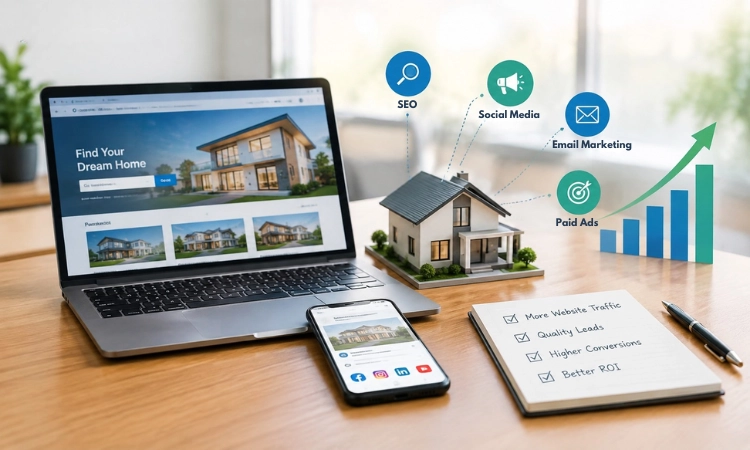
This is where digital marketing changes the game. Done right, it doesn’t just generate leads, it brings in the right leads: people who are genuinely interested, financially ready, and closer to booking a site visit. The result is fewer wasted calls for your sales team and a much stronger return on your marketing investment (ROI).
In this blog, we’ll walk through the complete digital marketing process for real estate businesses, from understanding your project and audience, to running targeted campaigns, converting clicks into enquiries, turning enquiries into site visits and sales, and finally, measuring what’s working so you can keep improving.
1. Start by Understanding Your Real Estate Business
Before a single ad goes live, the most important, and most often skipped, step is understanding the business itself. Jumping straight into running ads without this groundwork is like showing a 2BHK to someone who’s looking for commercial office space. It wastes budget and produces leads that never convert.
What Should You Analyze?
- Project and location, What are you selling, and where? Proximity to schools, highways, business hubs, or metro stations can be a major selling point.
- Target audience, Are you targeting first-time homebuyers, investors, NRIs, or businesses looking for commercial space?
- Market competition, What are similar projects in the area offering, and at what price point?
- Unique Selling Points (USPs), What makes your project stand out? Amenities, pricing, possession timeline, builder reputation?
- Business and sales goals, Are you aiming for quick sales velocity, premium positioning, or steady long-term bookings?
Why This Analysis Matters
- It helps create a marketing strategy tailored to your actual project, not a generic template.
- It sharpens audience targeting so ads reach people who are actually likely to buy.
- It prevents unnecessary ad spend on the wrong demographics or locations.
- It keeps every campaign aligned with real business goals, not just vanity metrics like impressions or clicks.
2. Reach the Right Audience at the Right Time
Once you understand your business, the next step is putting your project in front of people who are actively searching for or interested in properties like yours. This is where digital marketing truly outperforms traditional advertising, it lets you target intent, not just demographics.
Use Google Marketing to Reach High-Intent Buyers
Google Ads and SEO let you show up exactly when someone is searching with buying intent. This includes targeting searches for:
- Flats and apartments
- Villas
- Plots
- Commercial properties
- Property investments
- Local and “near me” searches (e.g., “3BHK flats near me,” “plots for sale in [city]”)
These are people actively looking to buy, not passively scrolling. Capturing them at this moment is one of the highest-value opportunities in real estate marketing.
Use Meta Marketing to Reach Potential Buyers
Facebook and Instagram work differently, they help you reach people based on who they are and how they behave, even before they’ve started actively searching. Targeting can be based on:
- Location, city, locality, or a radius around your project
- Age, gender, and demographics, matching your ideal buyer profile
- Interests and behaviour, home décor, real estate investment, loan enquiries, etc.
- Buying intent, signals like engagement with property-related content
- Retargeting, re-engaging website visitors and previous leads who showed interest but haven’t converted yet
Why Audience Targeting Improves ROI
- Less wasted ad spend on people who were never going to buy
- More relevant enquiries from people who match your buyer profile
- Better lead quality, which means less time chasing dead ends
- Higher chances of conversion, since the right people see the right message
3. Generate Quality Real Estate Leads
Getting the right audience to notice your project is only half the job. The next challenge is converting that attention into genuine, quality enquiries.
Create Attractive Ads That Get Attention
A scroll-stopping ad typically combines:
- Relevant property visuals (real photos or high-quality renders, not stock images)
- Strong headlines and offers that highlight value
- Clear calls to action (“Book a Site Visit,” “Download Brochure,” “Get Price List”)
Project-specific messaging that speaks to the exact buyer you’re targeting
Build High-Converting Landing Pages
Sending ad traffic to a generic website homepage is one of the biggest mistakes in real estate marketing. A dedicated landing page should include:
- Property/project details
- Key benefits and USPs
- Location advantages
- Images and videos
- A simple lead enquiry form
- A strong, visible CTA
Turn Clicks Into Genuine Enquiries
The buyer journey typically looks like this:
Ad → Landing Page → Enquiry Form → Lead → Sales Team
Every step in this chain needs to be smooth. A slow-loading landing page, a confusing form, or an unclear offer can break the chain and cost you a lead that was almost yours.
Focus on Lead Quality, Not Just Lead Quantity
Hundreds of leads look impressive on a report, but if most of them are irrelevant, wrong budget, wrong location preference, or not even looking to buy, they don’t help your business. What actually matters is generating leads that are genuinely interested in your specific project and closer to being sales-ready. A campaign that brings in 50 serious enquiries is far more valuable than one that brings in 500 unqualified ones.
A to Z Digital Marketing Glossary
Explore the complete A to Z Digital Marketing Glossary with easy-to-understand terms, definitions, and concepts every marketer should know.
Read More →4. Turn Leads Into Site Visits and Sales
Digital marketing does the heavy lifting of generating interest and opportunity, but converting that opportunity into an actual sale depends heavily on what happens next.
What Happens After a Lead Is Generated?
- Follow-up and calling
- Understanding buyer requirements
- Scheduling site visits
- Property presentations
- Relationship building
- Booking and documentation
- Property sale
Each of these steps requires timely, professional handling. A great lead can go cold in hours if there’s no follow-up.
Marketing and Sales Must Work Together
- Faster lead response, the sooner you call, the higher the chance of conversion
- Proper lead qualification, separating serious buyers from casual browsers
- Consistent follow-ups, most buyers don’t decide on the first call
- Better communication between marketing and sales teams, so marketing knows which campaigns are producing buyers, not just leads
Key point: Digital marketing brings the leads; an effective sales process converts them into customers. Neither works well without the other.
Benefits of Google Adwords for Small Businesses
Explore the benefits of Google AdWords for small businesses, from targeted reach and quick results to better leads, budget control, and measurable growth.
Read More →5. Measure Results and Improve ROI
One of the biggest advantages digital marketing has over traditional advertising is measurability. You don’t have to guess whether your marketing is working, you can track it.
Key Metrics to Track
- Leads generated
- Cost per lead
- Lead quality
- Site visits
- Conversion rate
- Sales generated
- Cost per acquisition
- Return on ad spend (ROAS)
- Overall marketing ROI
Use Performance Data to Improve Campaigns
- Identify high-performing campaigns and scale them
- Pause underperforming ads before they drain the budget
- Improve audience targeting based on what’s converting
- Optimize landing pages to reduce drop-offs
- Adjust budgets based on real, ongoing results, not assumptions
This is an ongoing process, not a one-time setup. The real estate market shifts, buyer behaviour changes, and campaigns need continuous refinement to keep delivering results.
6. Digital Marketing Services That Help Real Estate Businesses Grow
Search Engine Optimization (SEO)
- Improve Google visibility for your project and brand
- Generate organic traffic that doesn’t rely on ad spend
- Target property-related searches relevant to your project
- Build long-term, sustainable lead generation
Google Ads
- Reach active property buyers at the exact moment they’re searching
- Target high-intent searches
- Generate immediate enquiries, especially useful for new launches
Social Media Marketing
- Build awareness for your project and brand
- Reach potential buyers based on interests and behaviour
- Promote projects through engaging content on Facebook and Instagram
Landing Page Design & Optimization
- Convert paid traffic into enquiries
- Improve user experience across devices
- Increase conversion rates through testing and refinement
Content Creation
- Property blogs that build authority and SEO value
- Social media posts that keep your project top of mind
- Reels and videos that showcase the property visually
- Educational content that builds buyer trust
- Project-focused content that highlights specific USPs
Performance Tracking & Reporting
- Monitor campaign performance in real time
- Track leads and conversions across channels
- Identify what’s actually working
- Continuously improve ROI based on data, not guesswork
How to Rank Higher in Google Maps & Local Search
Want more local customers? Discover proven strategies to rank higher in Google Maps and local search and improve your business’s online visibility.
Read More →The Real Estate Digital Marketing Funnel
Put together, the entire process forms a simple, repeatable funnel:
Understand Your Business → Reach the Right Audience → Generate Quality Leads → Follow Up → Get Site Visits → Close Sales → Improve ROI
Each stage feeds into the next. Skipping or weakening any one stage, say, running ads without understanding the audience, or generating leads without a solid follow-up process, weakens the entire funnel and directly impacts your bottom line.
How Digital Marketing Can Deliver More Than Just Leads
When executed well, digital marketing does far more than fill up a leads spreadsheet. It delivers:
- More qualified leads, people genuinely interested in your project
- More property site visits, the real indicator of buying intent
- More sales opportunities, a healthier pipeline for your sales team
- Better business growth, sustained visibility and demand
- Higher marketing ROI, every rupee spent working harder for you
Why Choose a Result-Oriented Digital Marketing Strategy for Real Estate?
Not all digital marketing is created equal. A results-driven approach focuses on:
- Real estate-specific strategy, built around how property buyers actually search and decide
- Audience-focused campaigns, targeting people genuinely likely to buy
- Data-driven decision-making, decisions based on performance, not assumptions
- Transparent reporting, clear visibility into where your budget is going and what it’s producing
- Continuous optimization, campaigns that improve over time, not ones that are set and forgotten
- Dedicated support, a team that understands both marketing and real estate sales cycles
- Focus on measurable business results, leads, site visits, and sales, not just clicks and impressions
What is SEO and How It Helps to Grow Your Business
What is SEO and why does it matter? Learn how SEO helps improve Google rankings, attract targeted traffic, increase visibility, and grow your business online.
Read More →Conclusion
Digital marketing connects every stage of the real estate buyer journey, from the moment someone first sees your project online, to the enquiry they submit, the site visit they schedule, and finally, the sale you close. It’s this end-to-end connection that makes it so powerful for improving ROI.
But the real success of digital marketing for real estate isn’t about generating more leads, it’s about generating the right leads. A smaller number of genuinely interested, sales-ready buyers will always outperform a large pile of unqualified enquiries.
If your real estate business is ready to move beyond scattered advertising and build a strategy that actually turns online searches into real business outcomes, now is the time to act.
Ready to Generate More Real Estate Leads and Grow Your ROI? Let’s build a digital marketing strategy that turns online searches into real business opportunities.